About me Research Publications Data
LinkedIn Scholar ORCID ResearchGate
Chantal D'Amore

Hi! I'm Chantal D'Amore

Postdoctoral Researcher in Social Psychology

I am a Social Psychologist (PhD) and postdoctoral researcher at the University of Amsterdam, where I study the social-emotional dynamics of normative decline in collaboration with Gerben van Kleef.

My broader research interests lie at the intersection of political psychology and social psychology: political polarization (the dangers and benefits of it), moralization, norms, values, emotions, and social identities.

Here you can find more about my cv, research, publications, and data & materials.

✉️ c.damore@uva.nl

Chantal D'Amore

Academic Positions

May 2025 –
present
Postdoctoral Researcher in Social Psychology University of Amsterdam, Faculty of Social and Behavioral Sciences

Topic: The social-emotional dynamics of normative decline. Main collaborator: Gerben van Kleef.

Nov 2023 –
Apr 2025
Postdoctoral Researcher in Social Psychology University of Groningen, Faculty of Behavioral and Social Sciences

Topic: The psycho-social consequences of the Groningen Gas Extraction. Main collaborators: Michel Dückers & Annette Scherpenzeel.

Sept 2022 –
Dec 2022
Visiting PhD Researcher University of Queensland, Brisbane, Australia — School of Psychology

Visiting scholar at the Social Identity and Groups Network. Research collaboration with Charlie Crimston on the interplay between polarization, social identity, and morality.

Oct 2019 –
Dec 2023
PhD Researcher in Social and Political Psychology (Cum Laude) University of Groningen, Faculty of Behavioral and Social Sciences

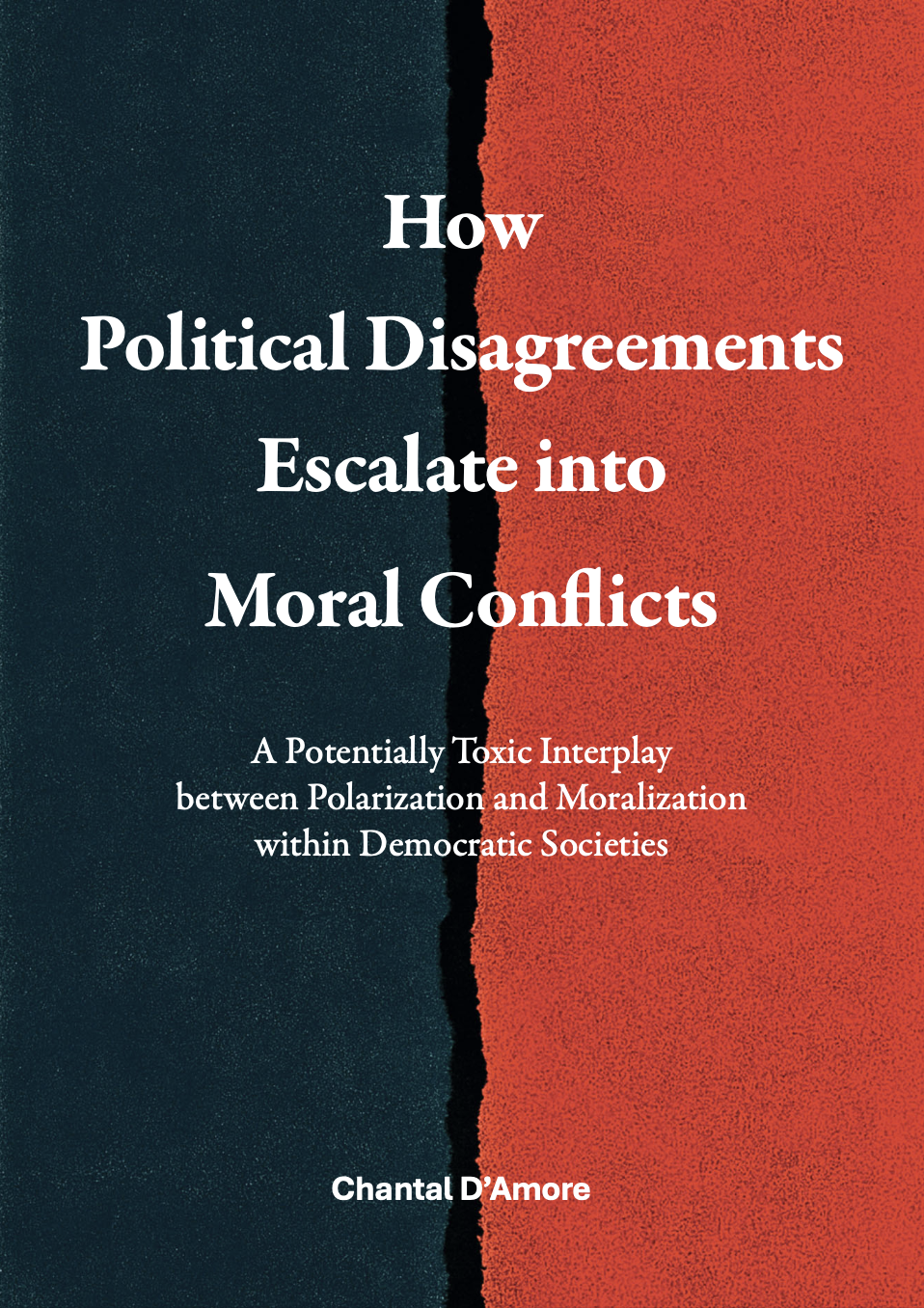
Thesis: "How Political Disagreements Escalate into Moral Conflicts: A Potentially Toxic Interplay between Polarization and Moralization within Democratic Societies".
Promotors: Prof. dr. Martijn van Zomeren & Prof. dr. Namkje Koudenburg.

Education

2017 – 2019
Master of Science in Behavioral and Social Sciences (Cum Laude) Research Master, University of Groningen — Specialization: Social Psychology
2014 – 2017
Bachelor of Science in Psychology University of Groningen — Minor in Social and Organizational Psychology
Bachelor Thesis in Statistics & Psychometrics

Teaching

Awards & Honours

CV

Download CV (PDF)

Research Themes & Projects

Polarization and Moralization Projects

PhD Thesis Book

A central part of my research focuses on political polarization and morality. This includes modern terms such as "culture wars," "echo chambers," and "identity politics." Through years of research, several of my studies (D'Amore et al., 2022, 2024, 2026) brought important insights about when and how people develop moralized beliefs about polarized topics — that is, the psychological process in which an opinion transforms into a fundamental belief of "good" versus "evil". This applies to many pressing societal topics including climate change, immigration/refugees, and equal rights for various (groups of) people. One of the main insights is when people perceive people with different opinions (as their own) as intentionally committing harm (e.g., in news messages), this trigger their moralization of the topic. Importantly, this triggering effect appeared to be strongest when people (a) perceive stronger polarization and (b) are embedded in networks that represent political "bubbles" (i.e., being surrounded by people sharing the same opinion). So, the more we believe that "others" are polarized and "my people" have similar viewpoints, the more we are susceptible to develop strong ideas not just about political topics but really about what is fundamentally "good" and "evil".
Polarization Triangle Framework

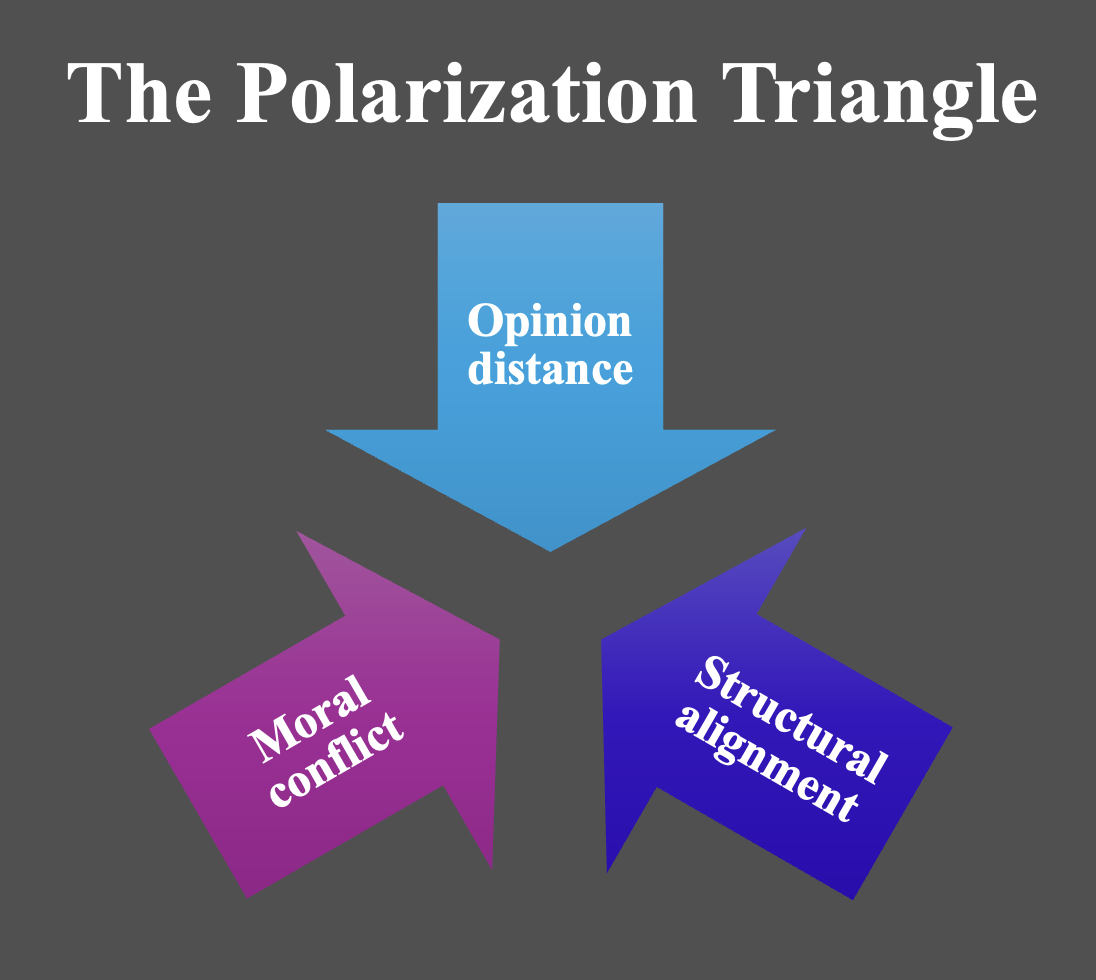
In another main research project, I zoom in on the phenomenon of polarization and examine the consequences of polarization for the individual and for society as a whole: Not all polarization is equal. While rising political disagreement is often portrayed as a threat to democracy, this chapter shows that the reality is more nuanced—and more hopeful. Using a systematic review of 173 empirical effects across 57 studies, the Polarization Triangle Framework reveals that polarization only becomes truly dangerous when three ingredients converge at once: people disagree on the issues, those disagreements are rooted in clashing moral values, and those moral-opinion divides are aligned with partisan identities. This toxic combination—called Structural Moral Opinion (SMO) polarization—is what predicts support for political violence, authoritarian leaders, and the erosion of democratic norms. Without the moral and structural ingredients, rising polarization actually motivates constructive political engagement. The takeaway? Societies should not fear disagreement—they should fear the moralization and structural entrenchment of it.
***MANUSCRIPT CURRENTLY UNDER REVIEW - soon to be published!***
- Reach out to me to receive the pre-print!

Other Projects

Social Network

More projects to be added soon!

- Exciting research on the social and emotional dynamics of norm violations is in progress. First insights will be shared soon!

Publications

Peer-reviewed science publications

D'Amore, C., Koudenburg, N., & van Zomeren, M. (2026). The social roots of moralization: Group-level emotions and attitudes drive individual moralization via social interaction. Group Processes and Intergroup Relations (Online First). — Open access, open data
Dono, M., D'Amore, C., Alzate, M., Brambilla, M., van Zomeren, M., & Sabucedo, J. M. (2026). Examining psychological effects of demagogic discourse on perceived threat and political intolerance. Current Psychology, 45(3), Article 237. — Open access
D'Amore, C., van Zomeren, M., & Koudenburg, N. (2024). How perceived polarization predicts attitude moralization (and vice versa): A four-wave longitudinal multilevel examination in the 2020 US election context. Journal of Personality and Social Psychology, 126(4), 624–642. — Open data
Van Zomeren, M., D'Amore, C., Pauls, I. L., Shuman, E., & Leal, A. L. (2024). The Intergroup Value Protection Model: A theoretically integrative and dynamic approach to intergroup conflict escalation in democratic societies. Personality and Social Psychology Review, 28(2), 225–248.
D'Amore, C., Van Zomeren, M., & Koudenburg, N. (2022). Attitude moralization within polarized contexts: An emotional value-protective response to dyadic harm cues. Personality and Social Psychology Bulletin, 48(11), 1566–1579. — Open access, open data

Public outreach

Invited speaker, public event The Social Animal in Tivoli Vredenburg, March 2025
Invited speaker, Psychology of Change (directed by Prof. Winnifred Louis, University of Queensland)
International Moral Psychology (IMP) series: Invited Speaker (coming up on Youtube) by Jim Everett

Talks

Conference presentations (selected)

International ISPP Conference 2025 (oral presentation), Prague, Czech Republic
National ASPO Conference 2025 (oral presentation), Groningen, Netherlands
International Norms Conference 2025 (oral presentation), Utrecht, Netherlands
National KLI Conference 2024 (two invited talks, KLI Best Paper Award recipient), Zeist, Netherlands
International EASP Conference 2023 (oral presentation), Krakow, Poland
International SASP Conference 2022 (oral presentation), Adelaide, Australia
International ISPP Conference 2022 (oral presentation), Athens, Greece
International ISPP Conference 2021 (oral presentation), online

Invited international lab group talks

Flinders University, Australia (2022)
University of Queensland, Australia (2022)
University of Padua, Italy (2021)

Data & materials

Open data & materials — D'Amore et al. (2022), PSPB

Open data and materials for "Attitude moralization within polarized contexts: An emotional value-protective response to dyadic harm cues." Experimental survey design with three Dutch samples.

Paper OSF

Analysis scripts & data — D'Amore et al. (2024), JPSP

Materials for the four-wave longitudinal multilevel study on perceived polarization and attitude moralization in the 2020 US election context.

Paper OSF

Analysis scripts & data — D'Amore et al. (2026), GPIR

Materials for the interactive group study on group-level attitudes and emotions driving attitude moralization.

Paper OSF

Pre-registrations

Pre-registrations for ongoing and completed studies are available on OSF.

OSF profile